Colonel John F. De Courcy on His Brigade’s Action in the Assault on Chickasaw Bluffs
Before he successfully captured Vicksburg, Mississippi in July 1863, Major General Ulysses S. Grant had made some attempts to capture that vital Mississippi River city that ended in failure. One of these was a December 1862 two pronged attack. Grant led one force that moved south from Tennessee through northern Mississippi, setting up supply bases along the way and using the Mississippi Central Railroad as his supply line. Major General William T. Sherman led a four division command down the Mississippi River to Chickasaw Bayou on the northern side of Vicksburg. Grant assumed—or hoped—the Confederates defending the city would be drawn out into battle with his army, leaving Vicksburg lightly defended for Sherman.
But Confederate cavalry disrupted Grant’s plans, destroying his supply bases and the rail lines, forcing him to retire. Grant tried to inform Sherman of this, but with telegraph lines down, he was unable to do so. Confederate reinforcements were sent to Vicksburg, and were well positioned on the high ground of the bluffs.
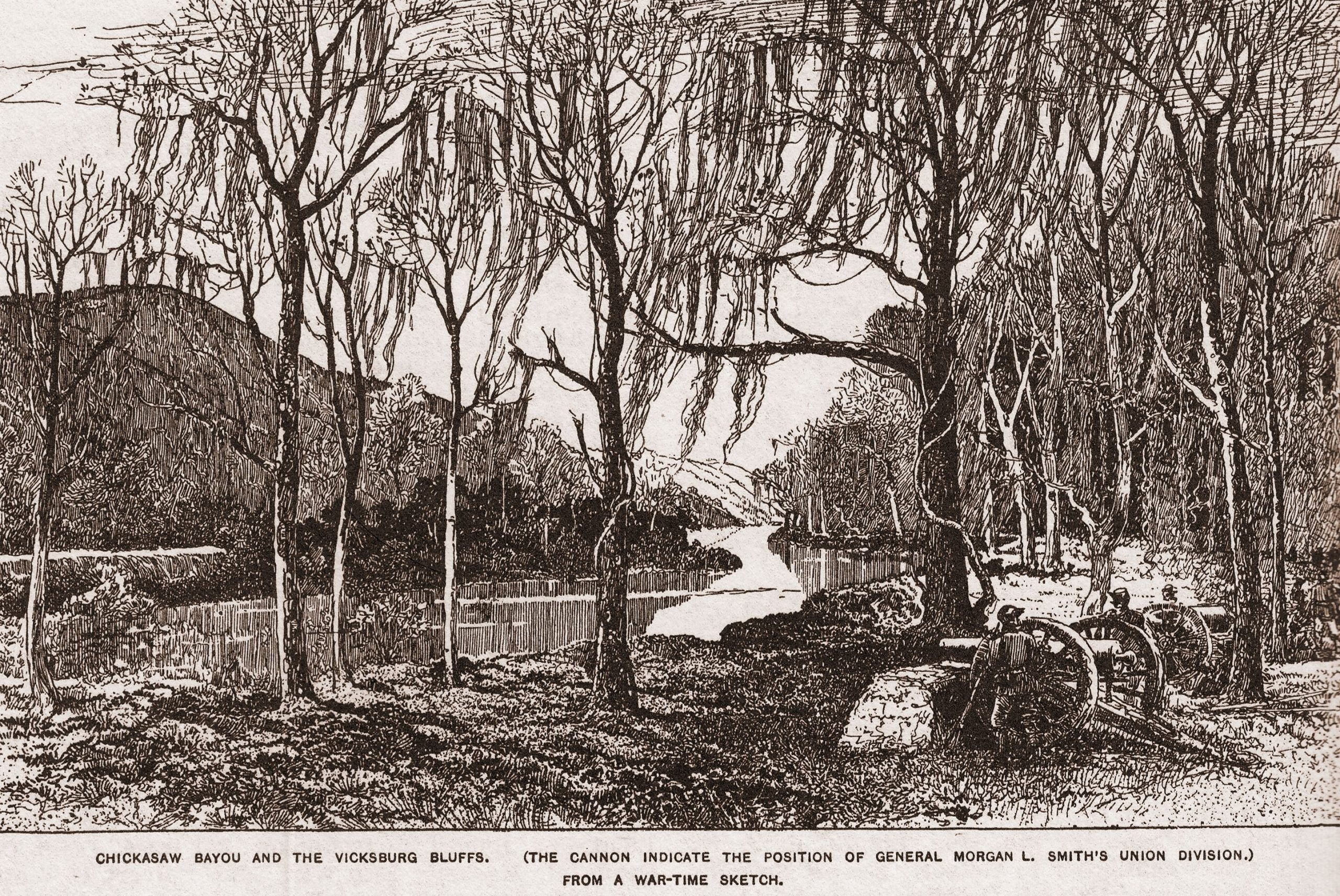
Sherman’s troops arrived at the Yazoo River, a tributary that emptied into the Mississippi just north of Vicksburg, on December 26th. The Federals had to maneuver through swampy ground and the tree filled Chickasaw Bayou. There was fighting on the 27th and 28th as the U.S. troops moved into position for an assault on the Chickasaw Bluffs on December 29th.
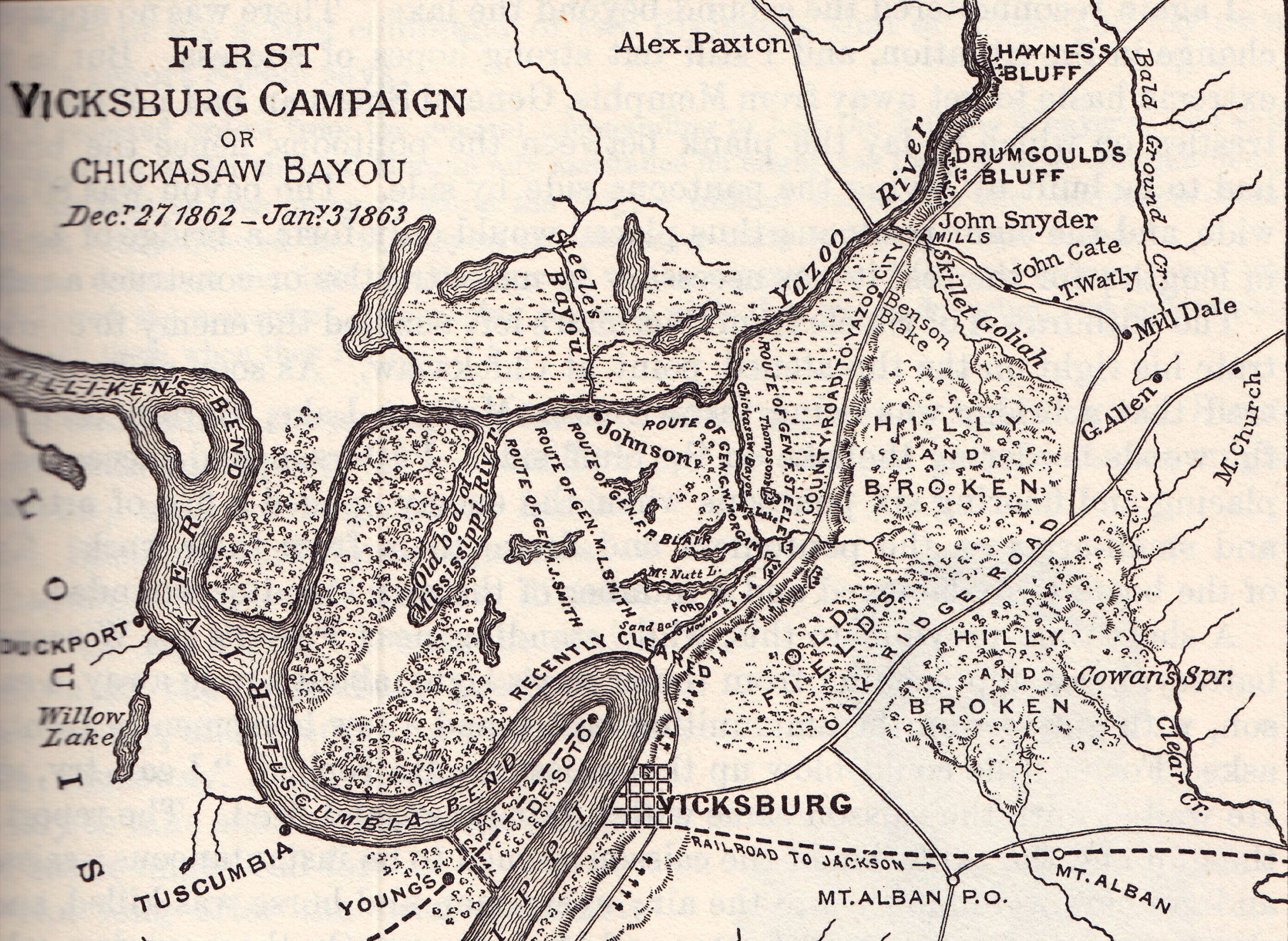
The attack on the morning of the 29th began with an intense artillery exchange. Captain Jacob T. Foster, commanding the 1st Wisconsin Battery of Light Artillery recalled the shelling:
The cannonading was opened at 7:30 a.m. and was truly terrific to us. Shell after shell burst among us and in the air just in front, sending in our midst a hail storm of bursting shell. At this moment it seemed as if all of their artillery fire was concentrated upon my battery, and continued until about 10 a.m., at which time, not having silenced us, they turned their guns on different parts of the field. During this part of the firing one of the enemy’s caissons was blown up, the rear chests of another shot off, and the hind wheel of a third shot from its axle…
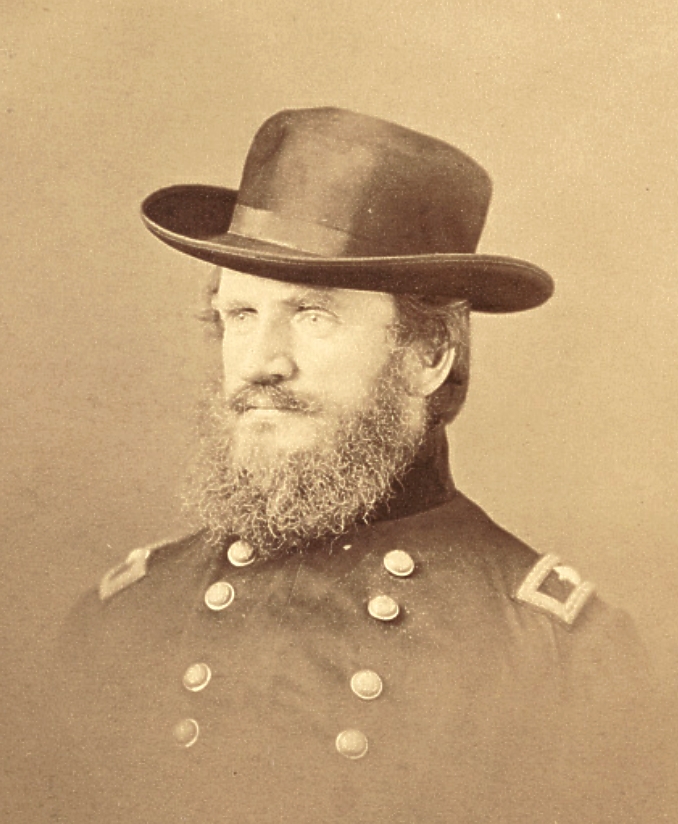
Brig. Gen. George W. Morgan USA
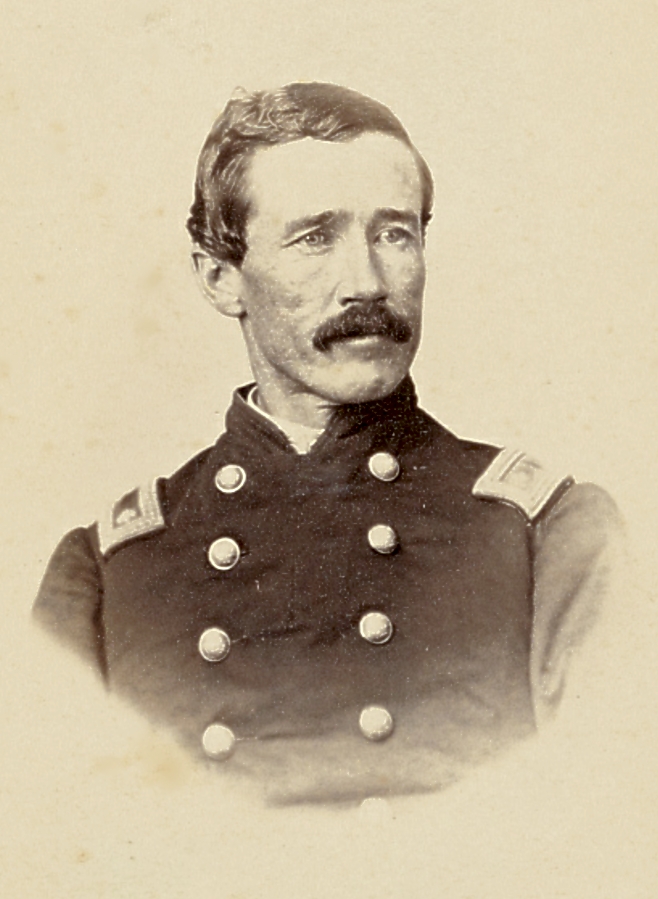
One of Morgan’s brigade commanders was Colonel John F. DeCourcy, commanding the 3rd Brigade. DeCourcy also expressed disbelief at the success of an assault on the position, but carried out his orders. DeCourcy’s brigade, consisting of the 54th Indiana, 22nd Kentucky, and the 16th and 42nd Ohio, would suffer some of the heaviest casualties of the battle.
DeCourcy described his brigade’s fighting in his after action report:
December 29, 1862.
Sir: At about 11 o’clock this day I received the order to prepare to advance with my brigade and attack the works on the Chickasaw Bluffs on my front. I formed the brigade in the following order: The Twenty-second Kentucky and Fifty-fourth Indiana deployed in line of battle (the former on the right), the Sixteenth Ohio and Forty-second Ohio in rear in double column; the Sixteenth Ohio supported the Fifty -fourth Indiana and the Forty-second Ohio supported the Twenty-second Kentucky.At ten minutes before 12 o’clock the order to advance was given and the Twenty-second and Forty-second Regiments found themselves immediately engaged under a hot fire in the toils of a nearly impassable abatis of heavy timber. But the gallant labor of these regiments was of no avail for the object in view, as I found that a deep and wide bayou separated the abatis from the open ground which we had yet to traverse before reaching the base of the enemy’s works. By this time the Sixteenth Ohio, Fifty-fourth Indiana, and a part of the Twenty-second Kentucky, having a much easier and less encumbered ground to march over, had dashed across the bayou on their front, and by a road had marched up to and deployed on the open ground which sloped up to the works which they were to attack. This attack they began immediately, in splendid style, and nearly accomplished their object, notwithstanding the immense and fearfully destructive fire which poured in from front, left, right, and even rear, for as soon as these regiments had advanced a few hundred yards toward the works the enemy opened with a battery in rear of the left of their advance.
Seeing that I could not cross the bayou at the point which the Twenty- second Kentucky and Forty-second Ohio had reached I ordered a flank movement by the left through the abatis, and as fast as it was possible and with hearty cheers these regiments moved to the support of the Sixteenth and Fifty-fourth which were just beginning their charge. In a short time the abatis was recrossed, the bayou passed over, and the head of the column emerged on the open ground; too late, however, to afford support or assist in the desperate charge. Notwithstanding the destructive fire from all sides, which kept mowing down the ranks of the Sixteenth Ohio, Twenty-second Kentucky, and Fifty-fourth Indiana, the brave men composing these corps had nearly crossed the large open space of more than half a mile which lay stretched out before them glacis fashion, when the enemy increased his fire of small arms and grape to such a degree as to render a farther advance impossible. Finding the retreat begun, and deeming it but the natural result of an advance over such an extent of open ground and under such an amount of concentric fire, I resolved not to expose the Forty-second Ohio to useless destruction. I therefore halted this regiment at the bottom of the road under the bank of the bayou and deployed it to cover the retreat of the repulsed regiments. The Forty-second Ohio, under the command of Lieut. Gol. Don A. Pardee, performed this duty with great steadiness, and re-entered our lines in perfect order under the directions of that able and gallant officer.
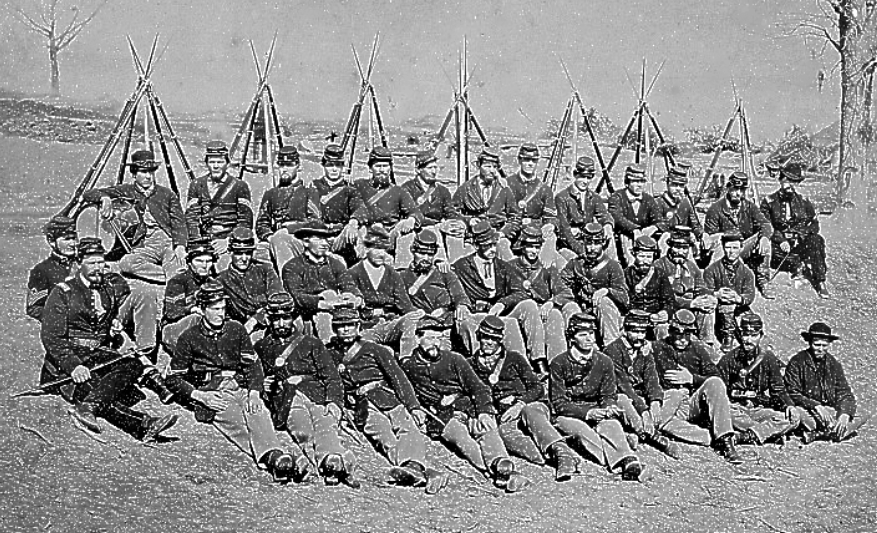
42nd Ohio Infantry, Company I
In this affair the Sixteenth Ohio was commanded by Lieut. Col. P. Kershner, who fell while leading the charge of the regiment. This excellent officer is supposed to be wounded and made
prisoner.Lt. Col. Philip Kershner, 16th Ohio Infantry
The Twenty-second Kentucky was under the orders of Lieut. Col. G.W. Monroe, who was wounded early in the charge. His wound not being a serious one I hope the valuable services of this officer will soon be available. The regiment was brought out of action by Maj. W. J. Worthington.
The Fifty-fourth Indiana was led by Col. F. Mansfield, who handled his young corps and showed his men so good an example as to make them behave with like bravery and constancy of the old regiments at their side.
All these regiments brought back their colors. The praises for the heroic bravery displayed by the officers, non-commissioned officers, and privates of the regiments in my brigade this day in the attack on the Chickasaw Bluffs is out of my province in this official report, but I must be allowed to say that no troops of any army could have done better, and perhaps few would or could have done so well.
Lieutenant Stein, acting assistant adjutant-general; Lieutenants Thomas and Risdon, of my staff, showed their usual cheerful alacrity in seeing all my orders carried out regardless of all or any kind of risks. These officers have been for nearly three days constantly under fire.
Yours, respectfully,
JOHN F. DE COURCY,
Colonel, Commanding Third Brigade.Lieutenant Saunders,
Acting Assistant Adjutant-General
After the assault was repulsed, Morgan recommended to Sherman that the attack not be renewed. Realizing that the Confederate position was too formidable to take by frontal assault, and finding no other way to take the bluffs, Sherman withdrew from the area on January 2nd, 1863.
DeCourcy’s four regiments listed casualties of 48 killed, 321 wounded, and 355 missing or captured, including casualties suffered on December 27th and 28th. Total Union losses for Chickasaw Bayou and Chickasaw Bluffs were 208 killed, 1005 wounded, and 563 missing or captured. Confederate casualties in this lopsided victory were 63 killed, 134 wounded, and 10 missing.
Follow this link for General Sherman’s Report on Chickasaw Bluffs
Sources:
The Assault on Chickasaw Bluffs by George W. Morgan. In Battles and Leaders of the Civil War, Volume III, edited by Robert Underwood Johnson and Clarence C. Buel
Official Records of the Union and Confederate Armies in the War of the Rebellion, Series I, Volume 17, Part 1
The Campaign for Vicksburg, Volume I by Edwin Cole Bearss
Amazon affiliate links: We may earn a small commission from purchases made from Amazon.com links at no cost to our visitors. For more info, please read our affiliate disclosure.


