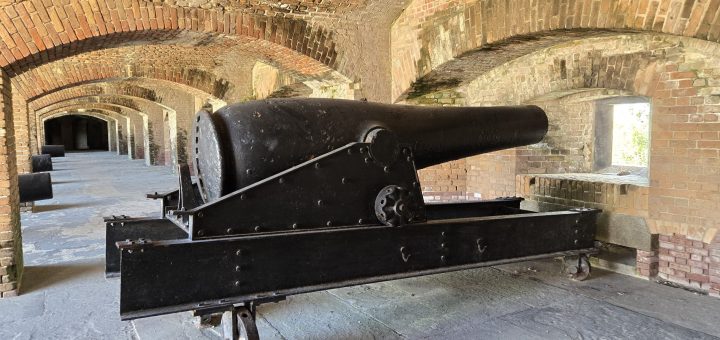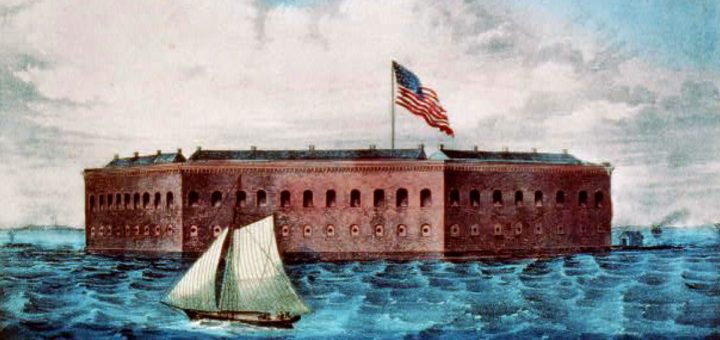
Iron Brigader began its blog with a poem by Edmund Clarence Stedman, a poet from Connecticut who served as a field correspondent for the “New York World” in the early years of the Civil War. Today, we bring you a poem written by a southerner, which versifies the April 13, 1861 bombardment of the Fort, [...]
150 Years Ago in the Civil War On April 5th 1861, Secretary of the Navy Gideon Welles ordered a Naval expedition to proceed to Fort Sumter in Charleston Harbor for the purpose of resupplying the garrison there. At the end of March, President Abraham Lincoln decided that Fort Sumter and Fort Pickens at Pensacola, Florida [...]
North Carolina was the last state to secede from the Union, doing so on May 20th 1861. The state contributed about 125,000 soldiers to the Confederacy, and of these, 19,673 were killed in battle and another 20,602 died of disease. This combined total of over 40,000 dead was the largest number of deaths of any [...]
Continue reading about North Carolina’s Civil War Sesquicentennial Commemoration
150 Years Ago in the Civil War This is the first of a series of overviews of the events of the Civil War in chronological order. These overviews will cover varying lengths of time depending on the number of events that occurred within the time frame covered. In this first post, I’ll cover November and [...]
Continue reading about Lincoln’s 1860 Election and Secession: November and December 1860
Tennessee was the last state to secede from the Union, holding off until June 8th 1861, or nearly two months after the war’s first shots were fired at Fort Sumter. Eastern Tennessee had a large population of Union loyalists but it was not enough to outvote the secessionists once fighting broke out. And the state [...]
Continue reading about Tennessee’s Civil War Sesquicentennial Commemoration
Fort Scott National Historic Site is located in the southeast Kansas city of the same name. Fort Scott was an important western military base for the Union Army during the Civil War, but it also served as a frontier fort from 1842-1853, acting as a buffer between settlers and the Native American tribes. It was [...]