General Marcellus Crocker’s Report on His Division in The Vicksburg Campaign

Gen. Marcellus M. Crocker
On May 2nd, 1863, Brigadier General Marcellus Crocker was assigned to temporary command of the 7th Division of Major General James B. McPherson’s 17th Corps, after the regular division commander, Brigadier General Isaac Quinby went on a sick leave. Crocker had studied at the U.S. military academy at West Point, but had to leave before graduating due to the death of his father and the need to provide for his family. Crocker became a lawyer in his home state of Iowa, and was practicing law when the Civil War began. In May of 1861, Crocker enlisted in the 2nd Iowa Infantry, and began his service as a captain with the regiment. By the fall, he had risen to Lieutenant Colonel, and before the year was out was made colonel of the 13th Iowa Infantry.
Crocker commanded the 13th Iowa at the Battle of Shiloh in April 1862, winning acclaim as a good battlefield commander. He was promoted to command of a brigade consisting of his 13th Iowa, plus four other Hawkeye infantry regiments, the 11th, 13th, 15th and 16th. Crocker led this brigade at battles at Iuka and Corinth, Mississippi in the fall of 1863, and was promoted to Brigadier General in November.
Major General Ulysses S. Grant noticed Crocker’s abilities as a soldier and commander, and selected him to take over for Quimby. The division consisted of three brigades of infantry under Colonels John B. Sanborn, Samuel A. Holmes, and George B. Boomer, along with a brigade of artillery. Crocker took over command the day after the Battle of Port Gibson, as Grant’s army began advancing into Mississippi.
Crocker’s division would see light action at the Battle of Raymond on May 12th, and more much more extensive fighting at both Jackson on May 14th and at Champion Hill on May 16th. Crocker’s division made the initial assault by the 17th Corps on the Confederate lines at Jackson. At Champion Hill, Crocker’s division played a key role in reinforcing the Union line and repulsing a Confederate counterattack by assaulting the Rebel right flank.

NPS Map of the Vicksburg Campaign
General Quinby had sufficiently recovered to resume command of the division for the remainder of the Vicksburg Campaign, including the assaults and siege of the city. Crocker filed this report on the actions of the division while he was in command:
Hdqrs. Seventh Division, Seventeenth Army Corps,
Before Vicksburg, Miss., May 25, 1863.Sir: I have the honor to report the part taken by the Seventh Division,
Seventeenth Army Corps, on the march and in the battles occurring
from the time I assumed temporary command of it at Port Gibson
on May 2, until relieved by Brigadier-General Quinby on the 17th instant.
I assumed the command of the division at Port Gibson at noon of
May 2, and that afternoon had the advance of the army corps, and
marched to the north branch of Bayou Pierre, on the road to Vicksburg.
On arriving at the bayou, we found that the bridge had been
burned by the retreating enemy. During the night the bridge was repaired
so that the corps could cross, and the next morning the division
crossed, following the division of Major-General Logan to Willow Springs,
at which point the division of General Logan was directed to take a
road to the left of the main road, the Seventh Division proceeding on
the main road toward Hankinson’s Ferry, on the Big Black River.
After proceeding a short distance, we encountered the enemy’s pickets,
and soon discovered the enemy, with a battery posted in the woods and
hills across a small creek. A regiment, the Fifty-ninth Indiana, commanded
by Colonel Alexander, was deployed as skirmishers, and the
two other regiments belonging to the same brigade, Colonel Sanborn’s
were formed in line of battle. A 10 pounder Parrott gun, under direction
of Captain [Frank C] Sands, chief of artillery for the division, was
placed in position, and soon succeeded in forcing the enemy’s battery to
retire to a less exposed position. The skirmishers and line were then
advanced across the creek, and the whole division deployed and ordered
to advance, when I received notice that the enemy had broken up his
formation and was in full retreat in the direction of Hankinson’s Ferry.
Their retreat from our front was doubtless greatly hurried by the advance
of the division of General Logan on their right flank.The two divisions, General Logan’s and the Seventh, were united at
the junction of the roads running from Grand Gulf and Willow Springs
to Vicksburg, one brigade of General Logan’s division preceding the
Seventh Division on the march from there to Hankinson’s Ferry.At Hankinson’s Ferry the division remained three days, bringing up
its supplies of ammunition and provisions, and on the morning of May
7 resumed the march, following General Logan’s division in the direction
of Utica. The march was continued, with slight interruption and
without incident, until May 12, on which day General Logan, having
the advance, encountered the enemy in the vicinity of Raymond. The
Seventh Division was hurried into position to support the division of
General Logan. Two regiments of the Second Brigade, under Colonel
Holmes, were sent to the right to support the brigade of General Stevenson,
and the First Brigade, under Colonel Sanborn, formed to the
left and rear of General Smith’s brigade, supporting the Eighth Michigan
battery, commanded by Captain De Golyer; the Third Brigade,
Colonel Boomer, held in reserve. Soon after making this disposition of
the troops, the enemy’s whole line broke and fled in confusion, and,
resuming our march, we proceeded without interruption to Raymond,
where we encamped. From Raymond we marched to Jackson, via Clinton,
following the division of General Logan to Clinton, where we again
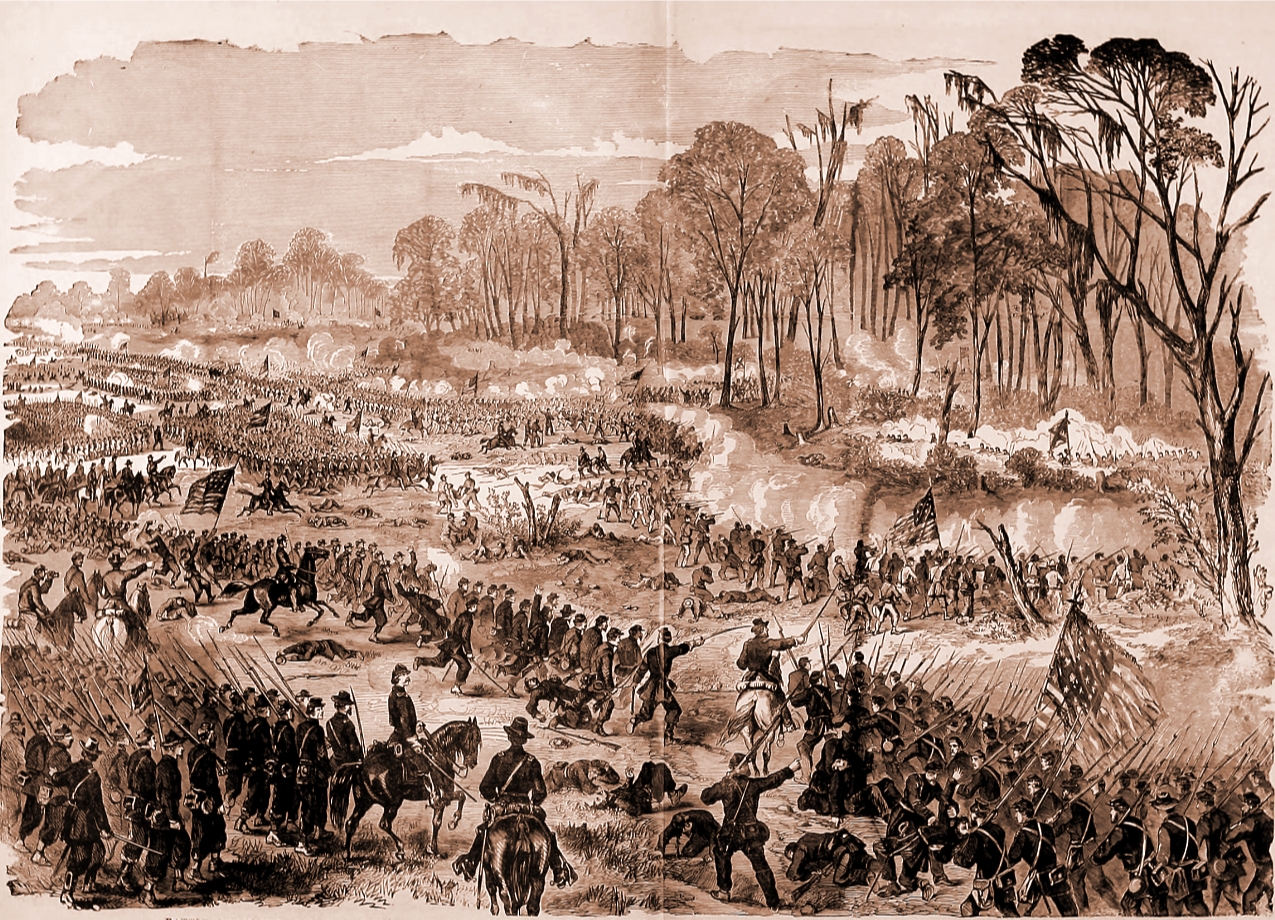
encamped.On the I4th, we proceeded in the direction of Jackson, the Seventh
Division having the advance, and marched without interruption until
within about 3 miles of Jackson, when we encountered the enemy in
strong position, his batteries posted so as to command the road and his
infantry covered by woods and ravines. The division was at once deployed,
the Second Brigade, commanded by Colonel Holmes, occupying
the right and left of the road; the First Brigade, commanded by Colonel
Sanborn, on the right and rear of the Second Brigade; and the Third
Brigade, under Colonel Boomer, to the left and rear of the Second Brigade,
this brigade in the woods. The line being thus formed, was
ordered to advance, which it did, followed by the Sixth Wisconsin
Battery, Captain Dillon commanding.Attack of Crocker’s Division at the Battle of Jackson Mississippi
The advance was made in the most gallant and satisfactory manner.
Not a man wavered or faltered, but proceeded, under the most galling
fire, to drive the enemy at the point of the bayonet from his strong
position. The battery advancing with the line of infantry, took position,
and, when the enemy broke and retreated, poured into the fugitives
an effective and destructive fire.The enemy having abandoned his position, it was supposed that he
would make a stand in his works before Jackson, but our skirmishers
and line steadily advanced into their works and into the town without
further resistance, taking possession of the works and seven guns, which
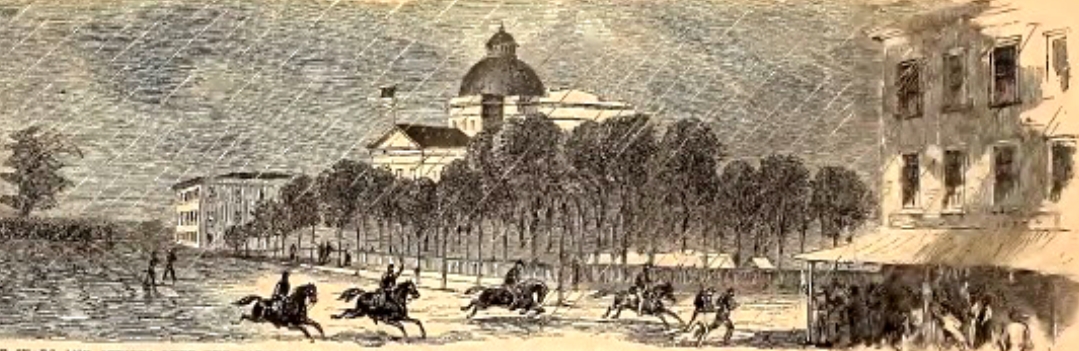
the enemy in his haste had neither injured nor attempted to carry away.Captain [Cornelius] Cadle, of my staff, and Captain Martin, acting assistant adjutant
general of the First Brigade, planted the flag of the Fifty-ninth Indiana
on the dome of the capitol of the State of Mississippi.Raising the Stars and Stripes Over Jackson Mississippi
On the morning of the 15th, we retraced our steps in the direction of
Clinton, General Logan’s division taking the lead. From Clinton we
proceeded [on the 16th] directly toward Vicksburg, the division of
General Logan still having the lead. Near Edwards Depot we came
up with the division of General Hovey, of Major-General McClernand’s
command, who, having the advance, encountered the enemy, posted
with great care and in strong force across Baker’s Creek, on what is
called Champion’s Hill. The two divisions, Generals Hovey’s and
Logan’s, were at once formed, General Logan’s on the right and General
Hovey’s on the left, and attacked the enemy with great fury, driving
him on both flanks. In the mean time two brigades of the Seventh
Division coming up, it soon became apparent that the enemy in front of
General Hovey was being re-enforced, and that he was hard pressed.
The Third Brigade, Colonel Boomer, was, therefore, ordered to proceed
to his support, which he did in the most gallant style, ascending a hill,
entering a wood, and taking position in front of an enemy of three times
his force. The First Brigade, under Colonel Sanborn, moved to the
right to support the batteries planted in the field.It soon became apparent that the critical point was our left. As General
Stevenson had been entirely successful in driving their left, the
enemy seemed determined to effect the same with ours; two of the regiments
of Colonel Sanborn’s brigade were, therefore, ordered to the
support of Colonel Boomer. Colonel Boomer, by the most desperate
fighting, and with wonderful courage and obstinacy, held his position
in spite of the continued and furious assaults of the enraged and baffled
enemy; but it was apparent that he sorely needed assistance, and, unless
speedily assisted, his position was in danger.Battle of Champion Hill
At this critical moment Colonel Holmes arrived in the field with two
regiments of the Second Brigade, the Seventeenth Iowa and Tenth Missouri,
and, being informed of the position of affairs, proceeded with the
greatest alacrity and enthusiasm to the front, relieving Colonel Boomer,
who by this time was entirely out of ammunition, and charged the enemy
with a shout, who broke and fled in the greatest confusion, leaving
in our possession the regimental flag of the Thirty-first Alabama, taken
by the Seventeenth Iowa, and two guns of his battery. This ended the
fight. Our right, under General Logan, had already driven them, and
when they broke on the left the rout was complete. That night we encamped
near the battle-field.On the morning of the 17th, Brigadier-General Quinby having returned,
I was relieved of the temporary command of the division.During the time that I commanded the division, the loss in the several engagements
was as follows: [Crocker listed 2 wounded on May 3rd, 2 killed at Raymond,
34 killed and 227 wounded at Jackson, and 123 killed and 539 wounded at Champion Hill.]Of the conduct of the officers and men of the division I cannot speak
too highly; their charge at Jackson, seldom if ever excelled in any
campaign, has been the theme of universal praise; the stubbornness and
courage with which they fought at Jackson and Champion’s Hill have
won for them the admiration of the army.To the staff of General Quinby I return my especial thanks for the
zeal, industry, and fidelity with which they discharged their difficult
duties during the march and on the battle-field. I am also under obligations
to Captain Cadle for the fidelity with which he discharged his
duties.Several brave, reliable, and valuable officers of the command were
killed in the different engagements, whose names and services are mentioned
in the reports accompanying. For full details of achievements
of the respective brigades and regiments reference is respectfully made
to the reports of brigade and regimental commanders forwarded herewith.Very respectfully, your obedient servant,
M. M. CROCKER,
Brigadier- General, Commanding Seventh Division.Lieut. Col. W. T. Clark,
Assistant Adjutant-General.

General Crocker received another division command later in the summer of 1863, but saw only minor action. During his military career, Crocker suffered from tuberculosis, (referred to as Consumption at that time) and it had taken a toll on his health to the point where he submitted his resignation in June of 1864. However, Grant did not want Crocker to resign, and the latter agreed to stay if assigned to a post in a dryer climate to cope with his illness. Crocker was assigned to Santa Fe, New Mexico, where he recovered to the degree that he requested field command in late 1864. Grant was happy to oblige, but confusion and government red tape slowed the process, and Crocker did not report for a new assignment. By the time he finally reached the east in the spring of 1865, his tuberculosis had returned, again rendering him unable to command, and the war was all but over anyway.
Crocker recovered somewhat and was ordered to Washington DC in later that year. The tuberculosis returned one more time; this time, it was fatal. Marcellus Crocker died in Washington on August 26th, 1865. He was 35 years old.
Sources:
The Campaign for Vicksburg, Volume II by Edwin Cole Bearss
Champion Hill: Decisive Battle for Vicksburg by Timothy B. Smith
Generals in Blue by Ezra J. Warner
Marcellus Crocker: Grant’s Hammer in the Western Theater by Frank Jastrzembski, Civil War Times, August 2020.
Official Records of the Union and Confederate Armies in the War of the Rebellion, Series I, Volume 24, Part 1.
Amazon affiliate links: We may earn a small commission from purchases made from Amazon.com links at no cost to our visitors. For more info, please read our affiliate disclosure.


