Colonel Powell Clayton on the Battle of Pine Bluff, Arkansas
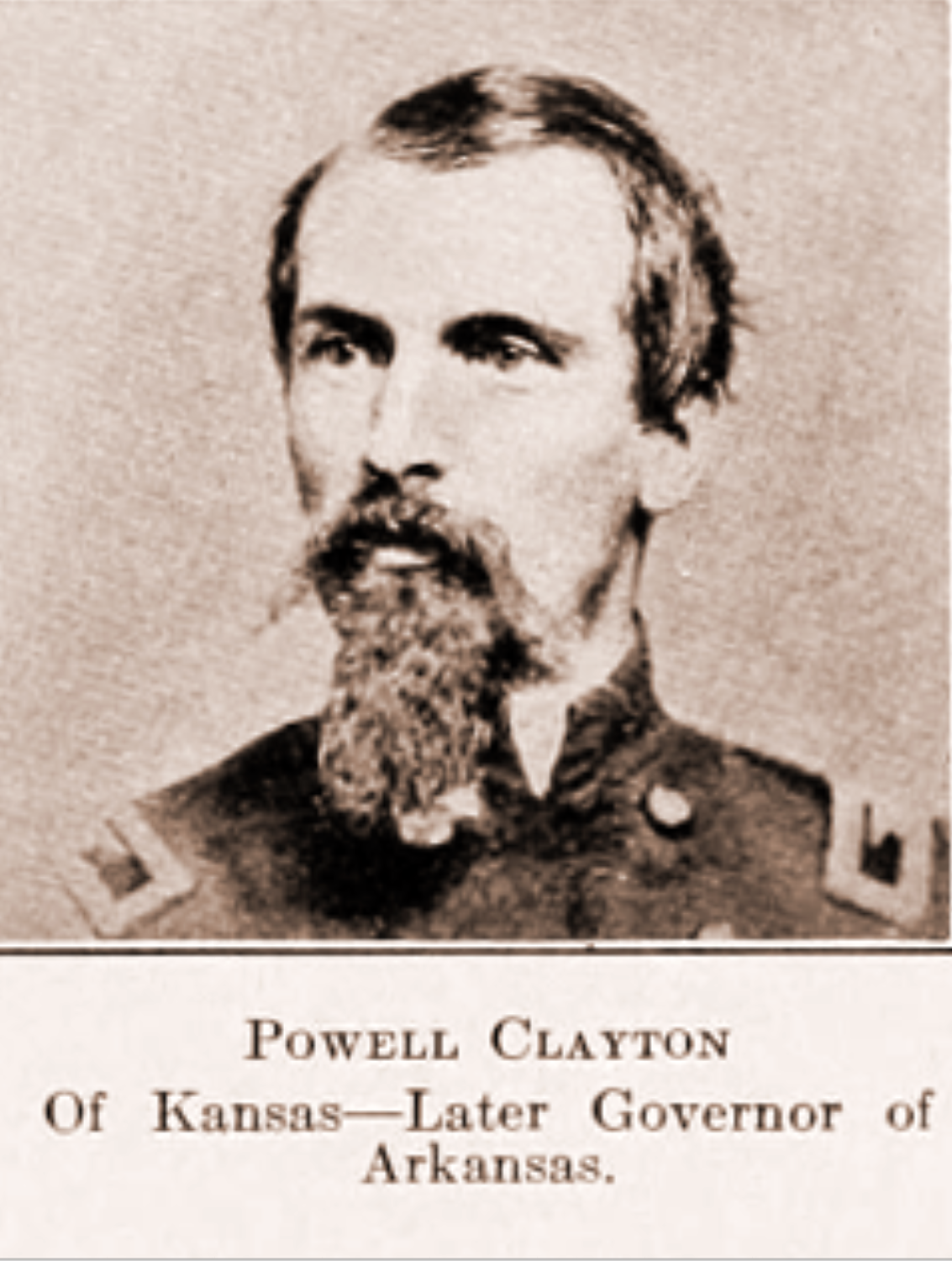
Pennsylvania native Powell Clayton was working as a civil engineer in Kansas when the Civil War began. Clayton began his military service in the spring of 1861 as a captain in the 1st Kansas Infantry. By March of 1862, he was the colonel commanding the 5th Kansas Cavalry. A very capable officer who would be promoted to brigadier general in 1864, Clayton served throughout the war in the trans-Mississippi region.
In the fall of 1863, Clayton was in command of the Union garrison at Pine Bluff, Arkansas. The garrison’s troops included Powell’s 5th Kansas Cavalry plus the 1st Indiana Cavalry, another veteran regiment. One company of Missouri State Militia was also present, bringing the total number of troops to about 550. The Federal garrison also attracted hundreds of escaped slaves, or Freedmen, who housed in a pair of camps outside of town.
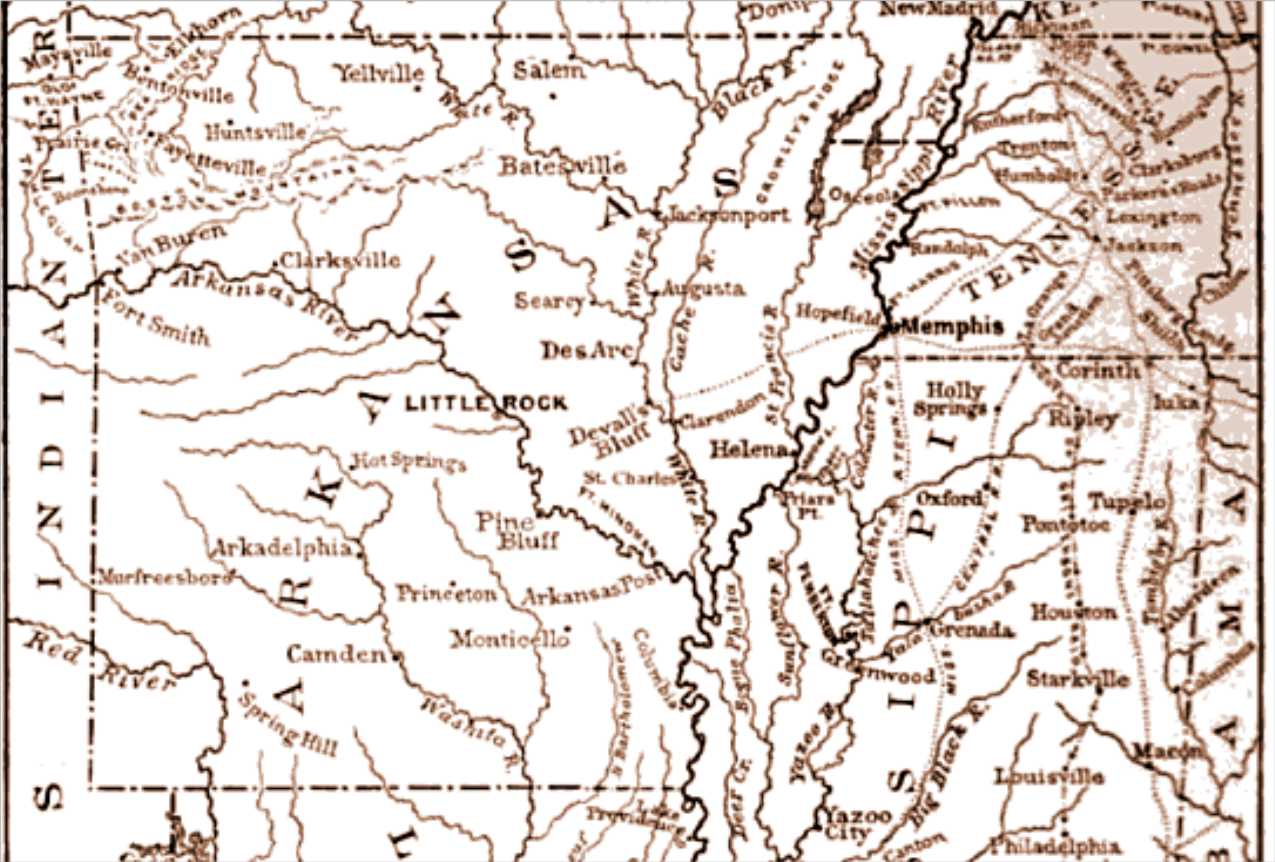
While the Union army garrison was setting up in Pine Bluff, Confederate cavalry under General John Marmaduke operated in the area. To keep tabs on the Rebels, Clayton and 300 troopers set out in search of the enemy, and launched a surprise attack on the camp of the 1st Arkansas Cavalry under Colonel Archibald S. Dobbins on October 11th, routing the Confederates and forcing them to flee. The Federals had Marmaduke’s attention, and the Rebels scouted the Pine Bluff garrison in preparation for an attack. On the 24th, Marmaduke’s force of 2300 cavalrymen and a dozen artillery pieces departed for Pine Bluff, arriving early on the 25th.
On the morning of the 25th, Clayton sent out a company of the 5th Kansas Cavalry on routine patrol. They didn’t have to travel far before making contact with advancing Rebel cavalry. Shots were exchanged, and any element of surprise for the attackers was gone. The Battle of Pine Bluff was on.
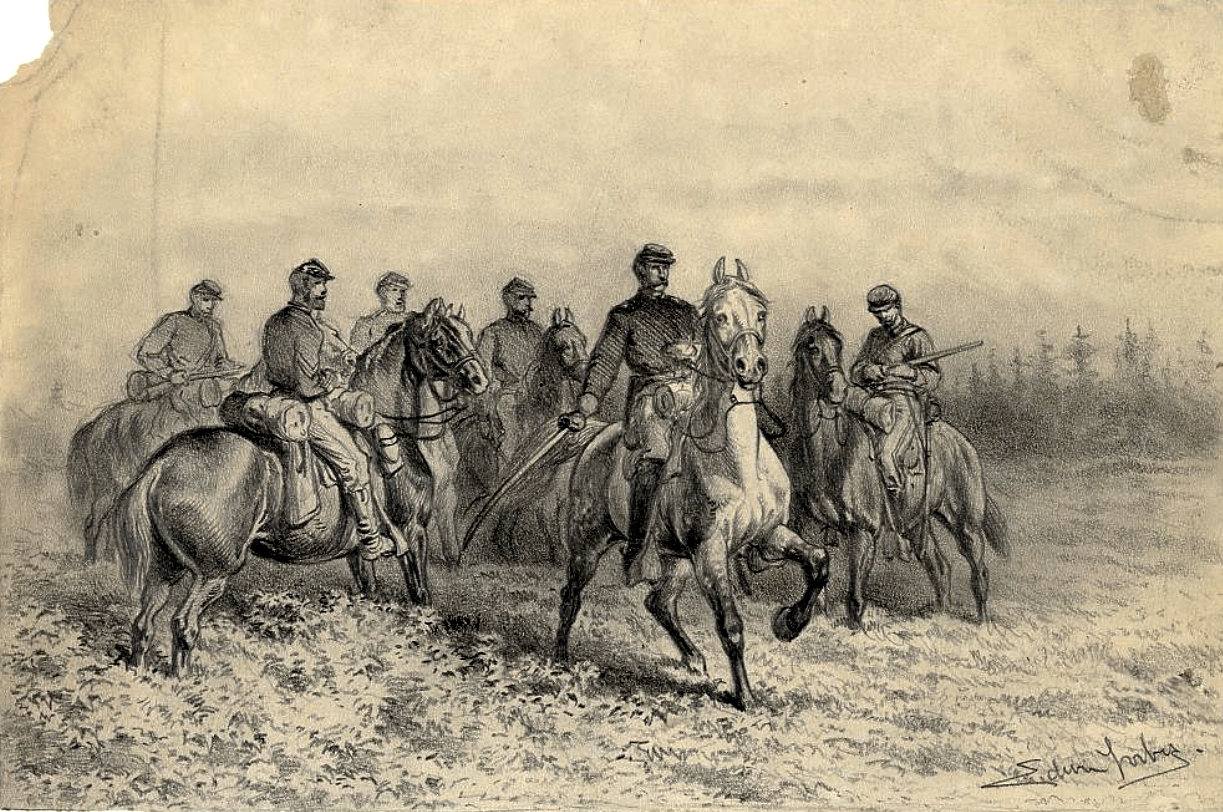
A Scouting Party by Edwin Forbes
Colonel Clayton filed this detailed report on the defense of Pine Bluff:
Headquarters Post,
Pine Bluff, October 27, X863.General: I respectfully submit to you the following report of the battle fought at this place October 25, between General Marmaduke’s forces and the garrison of this post:
About 8 o’clock in the morning I sent Lieutenant [M. F.] Clark, Fifth Kansas Cavalry, with one company, out in the direction of Princeton. He did not go far before he met the enemy advancing in force. The enemy’s skirmishers fired on him at once, but soon after, an armed party, bearing a flag of truce, came forward, and the officer in command of this party insisted that he should be allowed to pass in immediately. Lieutenant Clark told him it was no way to first fire on him, then insist on going in with a flag of truce; but he would give him half an hour for him (Clark) to send in to headquarters and get an answer. He rejected the proposition, and said he had dispatches from General Marmaduke to the commanding officer, he supposed, demanding a surrender of the place. The lieutenant replied, “Colonel Clayton never surrenders, but is always anxious for you to come and take him, and you must get back to your command immediately, or I will order my men to fire on you.” He fell back, and they commenced skirmishing again. Meantime the whole command was ordered out, and skirmishers sent in every direction; also 300 negroes set to work rolling cotton-bales out of the warehouses. In less than half an hour I had all the streets leading into court square completely and very formidably fortified with cotton-bales, and my artillery—six mountain howitzers and three small steel-rifled guns—planted so as to command every street leading into the square; my sharpshooters posted in all of the houses and other buildings on the square, so that the enemy could in no way approach the works only through the open spaces. I then had about 200 negroes commence carrying water from the river up to the square, and fill all the barrels they could find, so that, if
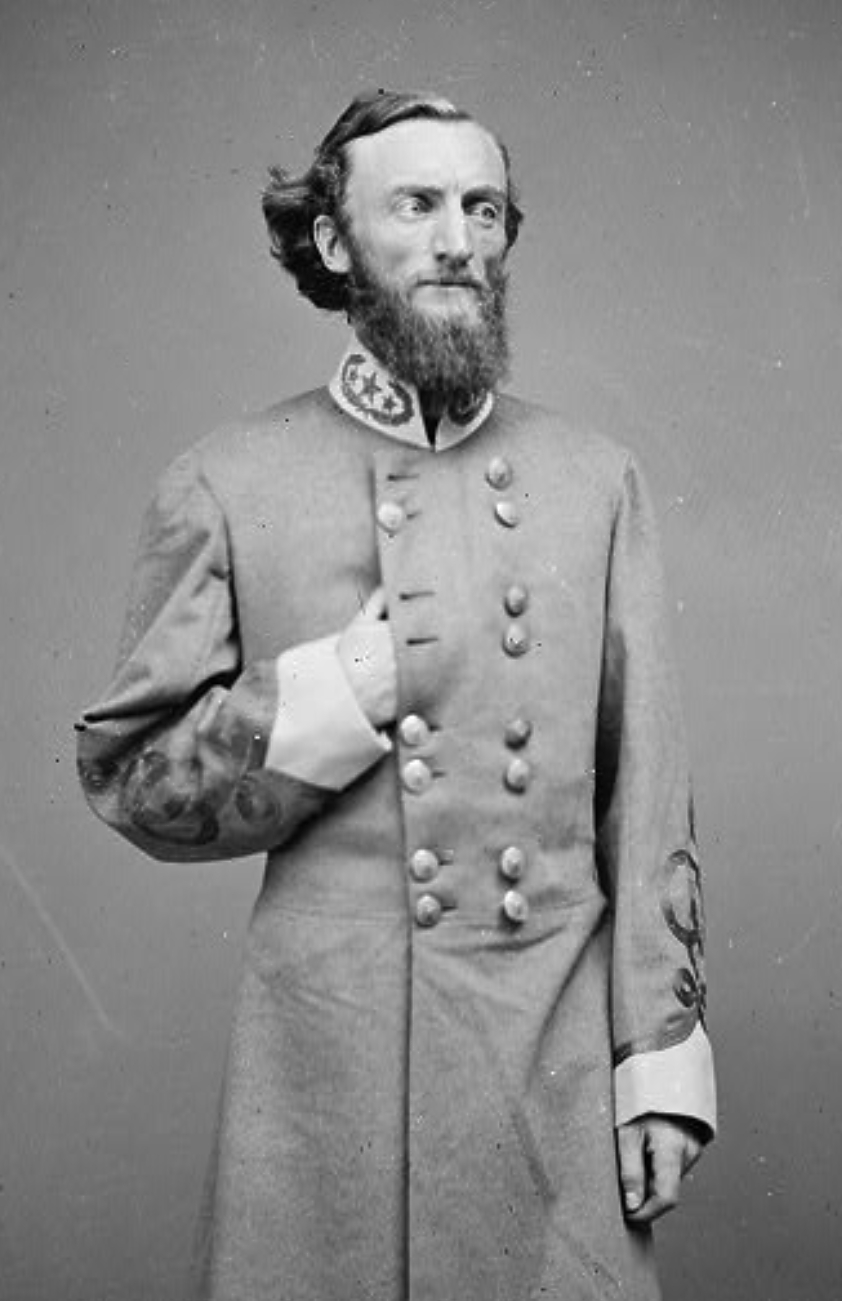
Gen. John S. Marmaduke CSA
necessary, I could hold out two days, even though cut off from the river. The enemy succeeded in driving in my skirmishers about 9 o’clock, and approached the works in three columns, as follows: On my right, center, and left, the main one being in the center, and opened on me with their artillery, twelve pieces, a part of which were 12-pounder rifle guns, throwing both the Hotchkiss and the James projectiles. The firing from both sides, from the artillery and sharp shooters, continued with great rapidity until 2 o’clock. Between 12 m and 1 p. m., the enemy set fire to the buildings on my right, expecting thereby to rout me; but I put some 200 negroes to carrying water and throwing it on the buildings immediately joining the square, and thus prevented the fire from doing me any damage. The enemy, seeing that he failed in his efforts to drive me by fire, as well as by force, planted another battery on my center, and kept up a heavy cannonading for a short time, then retreated (about 2 p. m.), leaving a great portion of his wounded and dead on the field. I followed him for about 1 mile, then returned and stationed my pickets as usual. My loss was 11 killed, 27 wounded, and 1 missing. There were also 5 negroes killed and 12 wounded. The enemy’s loss in killed and wounded, as far as ascertained, is about 130, and will probably reach 150. I have also 3 lieutenants and 30 men prisoners, 15 of whom are wounded. The buildings that were burned by the enemy were occupied by the Fifth Kansas Cavalry as quarters; consequently their camp and garrison equipage and their books and papers were all burned. The train was also corralled in sheds in rear of the buildings that were burned. When the fire was raging, the mules were cut loose to keep them from burning, and 62 of them are missing. The enemy also burned one warehouse, containing over 200 bales of cotton. In setting fire to these buildings, General Marmaduke committed the gross and barbarous deed of burning some of his own wounded. Several of his own men, who were wounded, were burned to death, and almost entirely consumed by the flames that he kindled. The court-house, General James’, General Yell’s and John Bloom’s houses were all nearly destroyed by the enemy’s artillery. There is scarcely a house in town that does not show the effects of the battle. The enemy plundered every house he could get to, and stole every horse and mule from the citizens that he could lay his hands on. The prisoners that I captured reported General Marmaduke’s force from 2,000 to 3,000 men, and twelve pieces of artillery. I think he had some 2,500 men and twelve pieces of artillery.
My force consisted of the Fifth Kansas Cavalry, commanded by Maj. Thomas W. Scudder, and the First Indiana Cavalry, commanded by Lieut. Col. Thomas N. Pace, and one company of State militia, commanded by Captain [B.] Murphy, amounting in all to some 550 men. Captain Murphy’s company behaved like veterans. The officers and men both of the Fifth Kansas Cavalry and of the First Indiana Cavalry behaved most admirably. The fact that so small a force kept four times their number at bay for five hours, and finally drove them from the field, bespeaks for the whole command greater efficiency and gallantry than words can do. Every officer and soldier in the whole command seemed determined to fight them as long as there was a round of ammunition left. The negroes also did me excellent service (see Captain Talbot’s report, which I fully indorse), and deserve much therefor.
I am, general, very respectfully, your obedient servant,
POWELL CLAYTON,
Colonel, Commanding.Major-General Steele,
Commanding Army of Arkansas
The 1st Indiana Cavalry reported three killed and nine wounded, while the 5th Kansas Cavalry had eight killed, 17 wounded and one missing. The company of Missouri State Militia reported one man wounded. The Freedmen had five killed and 12 wounded. In addition to being under fire while hauling water and performing other tasks, the officer in charge of the Freedmen camps, Captain James B. Talbot, reported that 15 men who had weapons participated in the defense against the Rebels.
For his part, General Marmaduke decided that only a frontal assault against the Union fortified positions would result in the garrison’s capture; he estimated that it would cost 500 casualties, and would not be worth it. He reported approximately 40 total casualties. The Confederates captured 250 mules and horses, along with 300 from the contraband camps, including men, women, and children; the women and children were left behind. The Rebels also destroyed a great deal of U.S. Army ammunition and supplies, along with hundreds of bales of cotton that had been destined for sale to the U.S. government.
Sources:
Civil War Arkansas 1863 by Mark K. Christ
Generals in Blue: Lives of the Union Commanders by Ezra J. Warner
Marmaduke Attacks Pine Bluff by Edwin C. Bearss. Arkansas Historical Quarterly, Vol. 23 No. 4, Winter 1964
Official Records of the Union and Confederate Armies in the War of the Rebellion, Series I, Volume 22, Part 1.
Amazon affiliate links: We may earn a small commission from purchases made from Amazon.com links at no cost to our visitors. For more info, please read our affiliate disclosure.


