Operations Against Confederates in Southern Missouri on Christmas 1863
Although there was less active campaigning in the winter in the Civil War, the war was ongoing and there was no Christmas or holiday break. U.S. forces battled guerillas and other irregular fighters constantly in Missouri, and Christmas 1863 was no exception. Here are a couple of examples of the action taking place in southern Missouri at that time.
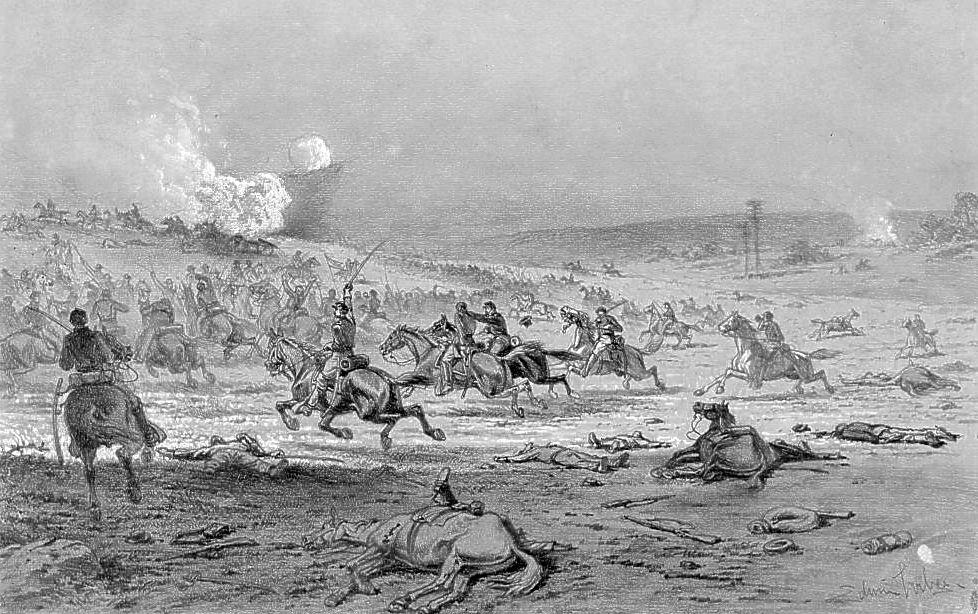
A Cavalry Charge by Edwin Forbes
On the 23rd of December, Major James Wilson and his 3rd Missouri State Militia Cavalry departed the U.S. garrison at Pilot Knob, Missouri in pursuit of Confederate guerillas that had captured a company of the 3rd Militia at Centerville, Missouri. Wilson and his cavalrymen rode south and overtook the guerillas encamped about 17 miles south of Doniphan, Missouri near the Arkansas line on Christmas Day. Wilson filed this report on that action:
Hdqrs. Third Missouri State Militia Cavalry,
Pilot Knob, Mo., December 30, 1863.Sir: In compliance with your orders of the 23d instant, I left Pilot Knob, in command of 200 men, about 10 a. m. December 23, 1863, arriving at Patterson at 9 p. m. Left there at daylight on the 24th, and encamped at Long’s at 9 p. m., having traveled 35 miles. Marched again at 3 a. m. 25th instant; passed through Doniphan, taking a southwesterly direction toward the Arkansas line. Eight miles from Doniphan, I captured 2 pickets; 2 miles farther I captured one other post, and still 2 miles farther on came upon a rolling picket or patrol, and run them off of the road, capturing 1 and compelling him to lead us to the camp of Reves. Arriving at the camp, I divided my men into two columns, and charged upon them with my whole force. The enemy fired, turned, and threw down their arms and fled, with the exception of 30 or 35, and they were riddled with bullets or pierced through with the saber almost instantly. The enemy lost in killed about 30; wounded mortally, 3; slightly, 2; total killed and wounded, 35. Prisoners captured, 112; horses, besides those of Company C, 75; also all their arms, ammunition, and camp equipage. Not having means of transportation, I was compelled to destroy the bigger portion of the arms and all the tents and other camp equipage.
On the morning of the 26th, I started for Pilot Knob, arriving here about 4 p. m. on the 29th of December, 1863.
I cannot speak in too high terms of praise of the officers and men under my command. There was no loss on our side in killed or wounded.
JAMES WILSON,
Commanding Third Missouri State Militia Cavalry.Col. E. G. Woodson,
Commanding Post, Pilot Knob, Mo.
Reves was Colonel Timothy Reeves, as his last name was also spelled.

Federal camp at Pilot Knob, Missouri
Meanwhile, to the west of Wilson, Lieutenant John E. Phillips of the 3rd U.S. Cavalry dispatched two scouting expeditions on December 24th from the Union post in Cassville, Missouri, for operations in the southwestern part of the state. The Federals were kept very busy rooting out Confederate guerillas over the next few days.
Headquarters Post,
Cassville, Mo., January 4, 1864.General: I forward report of two scouts, one under command of Lieutenant [A. A.] Irwin, the other in charge of Lieut. A. J. Garner, Second Arkansas Cavalry.
On the 24th ultimo, I gave orders to Lieutenant Garner to proceed in the direction of and beyond Pineville and reconnoiter with 50 men, and ascertain, if possible, the movements of Stand Watie, who was said to be in that neighborhood with 500 or 600 men.
Union Cavalry Scouting
Lieutenant Garner arrived on Cowskin Creek; found that Stand Watie had been there, but left the day before. He followed his trail to the line; but the enemy being too far ahead, the pursuit was fruitless, and abandoned. At the headwaters of Butler’s Creek, where he had turned out, Lieutenant Garner found and took possession of a cave, with a blacksmith’s shop, and about 100 bushels of corn in it. He destroyed it all. Ten miles below, on the same stream, in another cave, of 3 guerrillas found there, 1 was killed, 1 wounded, the other escaped. In this cave Lieutenant Garner found a small parcel of dry goods, about 2 pounds of gunpowder, 1 bushel salt, 1 shotgun, and 1 rifle. These, but the dry goods, he ordered destroyed. From a point 12 miles farther down stream, he scouted in various directions, and found himself in a section of country swarming with guerrillas. He burned four houses on Butler’s Creek, and seized three yokes of oxen and as many wagons. On his return, the 29th ultimo, he turned over the captured property to the quartermaster at this post. He had marched, while scouting and reconnoitering, about 150 miles. In the mean time information was received that one of my men, under Lieutenant [J.] Brown, had been wounded by guerrillas near Cross Hollow. I dispatched Lieutenant Irwin to that vicinity with 26 men. There he joined Lieutenant Brown. With his party augmented by 4 of Lieutenant Brown’s men, the balance of whom were ordered to return to Cassville to escort the wounded man. Lieutenant Irwin, hearing of the noted guerrilla Glover, of that neighborhood, proceeded to his house, and set fire to it. Glover was not there. From that place he advanced in a northeasterly direction, and, at a distance of about 1 mile from the burning house, made out 3 bushwhackers lurking in his front. He gave chase for about 2 miles, in vain; the guerrillas had taken refuge in the brush. At night (27th of December, 1863) Lieutenant Irwin camped at Black’s Mill. Next morning his pickets were fired into; but the enemy fled on the approach of Irwin’s party. From Black’s Mill, Lieutenant Irwin descended in a southeasterly direction, on White River. At the ford saw, but failed to capture or kill, a mounted guerrilla. Crossed over to the northeast, among the hills bordering the river, and, in a ravine, at the residence of Coon Baker, the most notorious guerrilla of that region, surprised John Roller, another bandit. In attempting to escape, this Roller was shot dead, and his horse, arms, and accouterments captured. They were turned over to the quartermaster at the post. Lieutenant Irwin thence proceeded northwest toward Indian Creek. Here another guerrilla and robber (Hairbright) was shot. The hills known as Roller’s Ridge were next searched. They are a well-known rendezvous for bandits, murderers, and highwaymen. Nothing was found, and Lieutenant Irwin, after four days of meandering march through a very rugged country, his horses tired, almost exhausted, returned to this post on the 30th ultimo without injury or loss. He marched about 125 miles.
I am, very respectfully, your obedient servant,
JOHN E. PHELPS,
Lieutenant Third U. S. Cavalry, Commanding Post.Brig. Gen. John B. Sanborn,
Commanding District of Southwestern Missouri.

Source:
Official Records of the Union and Confederate Armies in the War of the Rebellion, Series I, Volume 22, Part 1
Amazon affiliate links: We may earn a small commission from purchases made from Amazon.com links at no cost to our visitors. For more info, please read our affiliate disclosure.


